Best MCP Memory Servers in 2026: 9 Options Compared
Disclosure: Membase is our product. We list it first because it’s the server we know best, and we say plainly where another server is the better fit. Licenses, pricing and setup were checked on vendor docs, pricing pages and GitHub in October 2026. See “How we compared” at the end.
Quick links: Get a free Membase API key · Membase MCP setup · Docs · GitHub · 1-min Claude Code demo
TL;DR
- An MCP memory server gives Claude Code, Cursor, Claude Desktop and other MCP clients a memory that lasts beyond one session.
- Membase: the memory layer for AI agents. One memory shared by your own agents and your AI tools, hosted or local. Free in beta.
- Knowledge Graph server: the official reference server. One npx command, a local file, free.
- Basic Memory: memory as Markdown notes you can open in Obsidian.
- mcp-memory-service: self-hosted memory for several agents, with a REST API and dashboard.
- Mem0: hosted MCP server for teams already on Mem0. OpenMemory is deprecated.
- Supermemory: hosted MCP with OAuth sign-in and data connectors.
- Graphiti: self-hosted temporal graph for facts that change over time.
- Cognee: knowledge graph plus vectors, built from documents.
- Zep Context MCP: managed, per-user graphs and SSO for organizations.
What is an MCP memory server?
The Model Context Protocol (MCP) lets AI tools call external tools in a standard way. A memory server is an MCP server whose tools save and search information, such as add_memory and search_memories. Connect one to Claude Code and it can remember project decisions next week; connect the same server to Cursor and both tools draw on the same memory.
Claude Code has no built-in memory beyond files like CLAUDE.md, so a memory server is how you give it long-term recall without writing code.
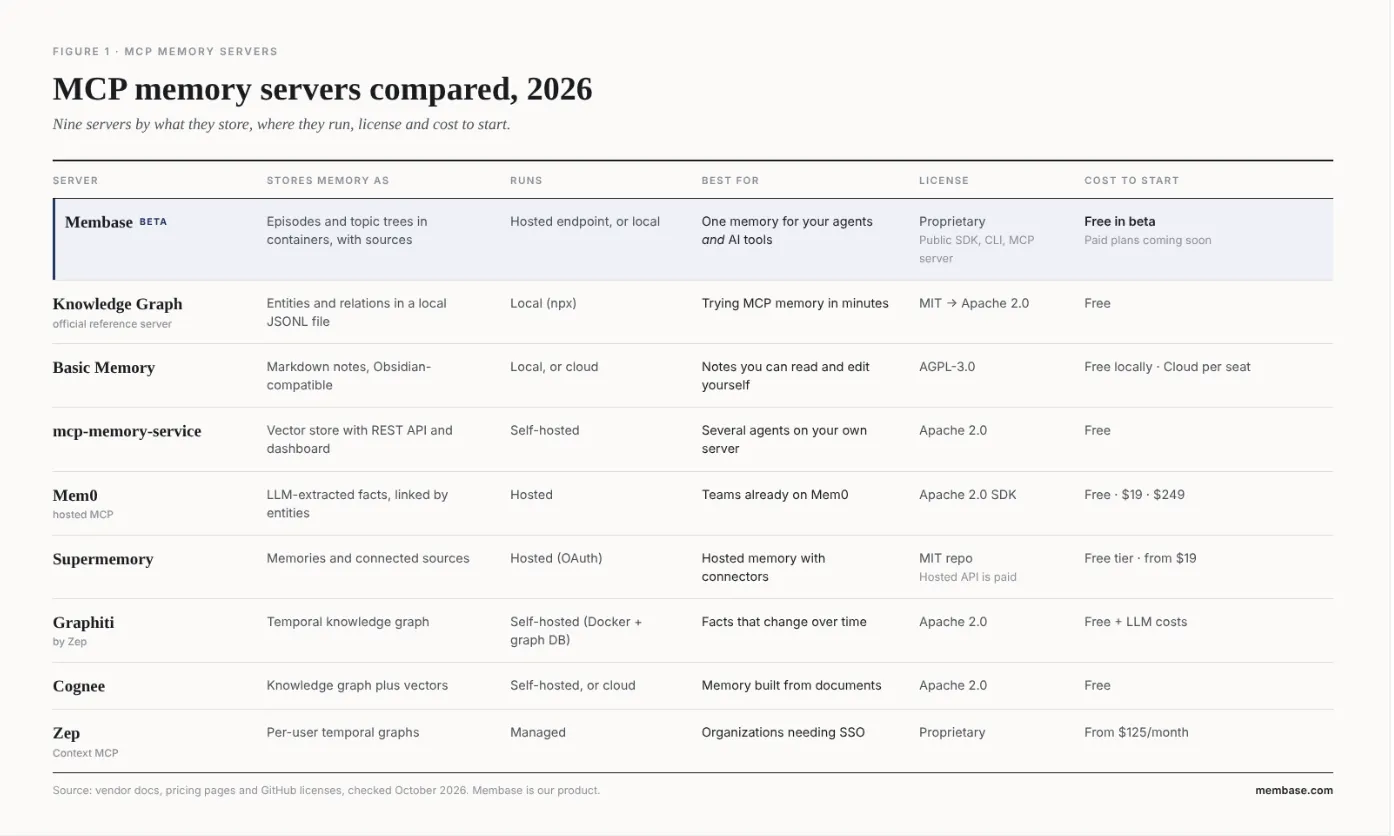
MCP memory servers at a glance
| Server | Stores memory as | Runs | Best for | License | Cost to start |
|---|---|---|---|---|---|
| Membase (beta) | Episodes and topic trees in containers, with sources | Hosted endpoint, or local | One memory for your agents and AI tools | Proprietary; SDK, CLI and MCP server public | Free in beta · Paid plans coming soon |
| Knowledge Graph (official) | Entities and relations in a local JSONL file | Local (npx) | Trying MCP memory in minutes | MIT → Apache 2.0 | Free |
| Basic Memory | Markdown notes, Obsidian-compatible | Local, or cloud | Notes you can read and edit yourself | AGPL-3.0 | Free locally · Cloud per seat |
| mcp-memory-service | Vector store with REST API and dashboard | Self-hosted | Several agents on your own server | Apache 2.0 | Free |
| Mem0 (hosted MCP) | LLM-extracted facts, linked by entities | Hosted | Teams already on Mem0 | Apache 2.0 SDK; Platform is managed | Free · $19 · $249 |
| Supermemory | Memories and connected sources | Hosted (OAuth) | Hosted memory with connectors | MIT repo; hosted API is paid | Free tier · from $19 |
| Graphiti (by Zep) | Temporal knowledge graph | Self-hosted (Docker + graph DB) | Facts that change over time | Apache 2.0 | Free + LLM costs |
| Cognee | Knowledge graph plus vectors | Self-hosted, or cloud | Memory built from documents | Apache 2.0 | Free |
| Zep (Context MCP) | Per-user temporal graphs | Managed | Organizations needing SSO | Proprietary | From $125/month |
How we chose
We looked at five things that decide whether a memory server works for you:
- Where the memory lives, and whether you can export it.
- What each write costs. Some servers run an LLM on every save to extract facts; others store text as is.
- What happens when a fact changes. Overwrite, keep both, or track history.
- Who can reach it. One tool on one laptop, or several agents and teammates with their own access.
- Setup. One command, or a database and Docker.
1. Membase: one memory for your agents and AI tools
Membase, built by Unibase, is the memory layer for AI agents. Teach it something once, and your own agents, Claude Code, Cursor, Codex and ChatGPT all remember it: AI tools connect over MCP, and your own agents use the Python or TypeScript SDK.
claude mcp add --transport http --scope local membase \
  https://api.app.membase.com/mcp-http \
  --header "Authorization: Bearer ${MEMBASE_API_KEY}"
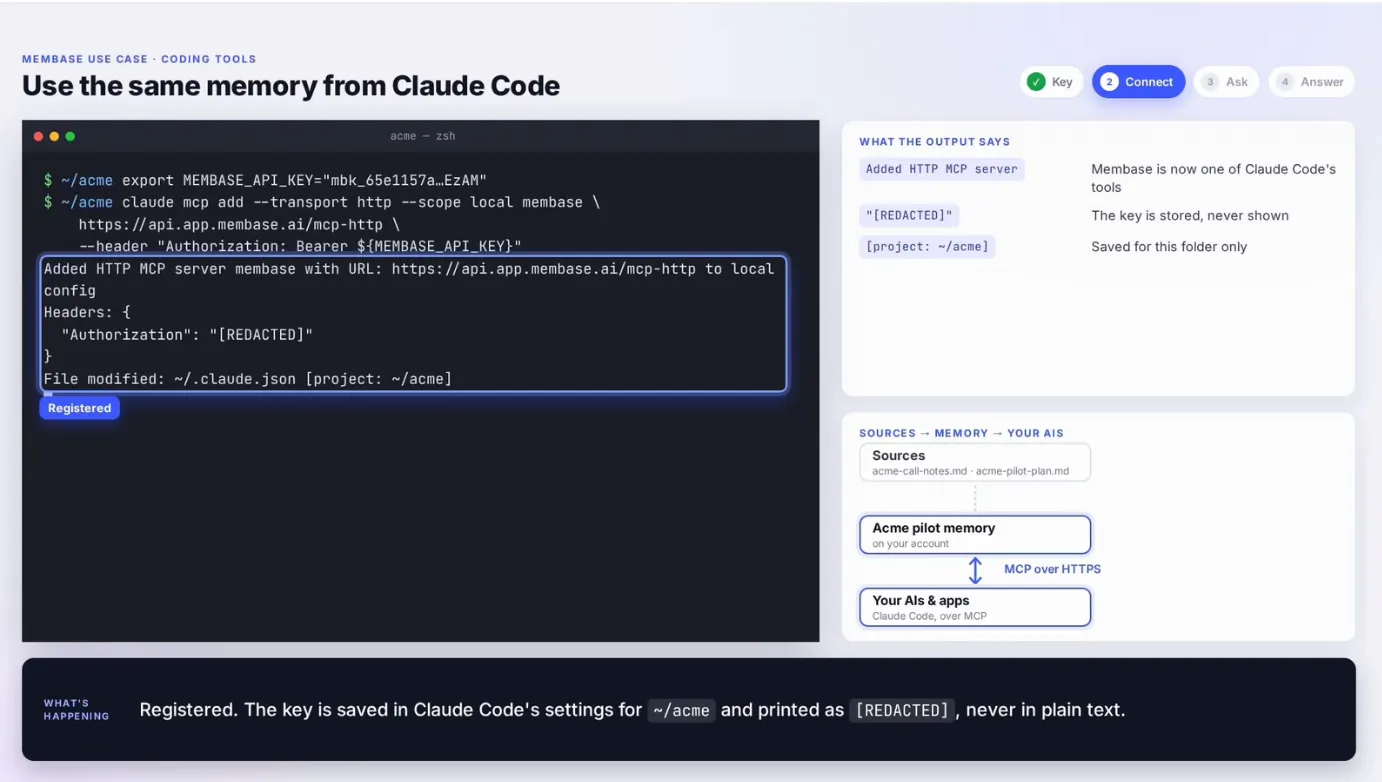
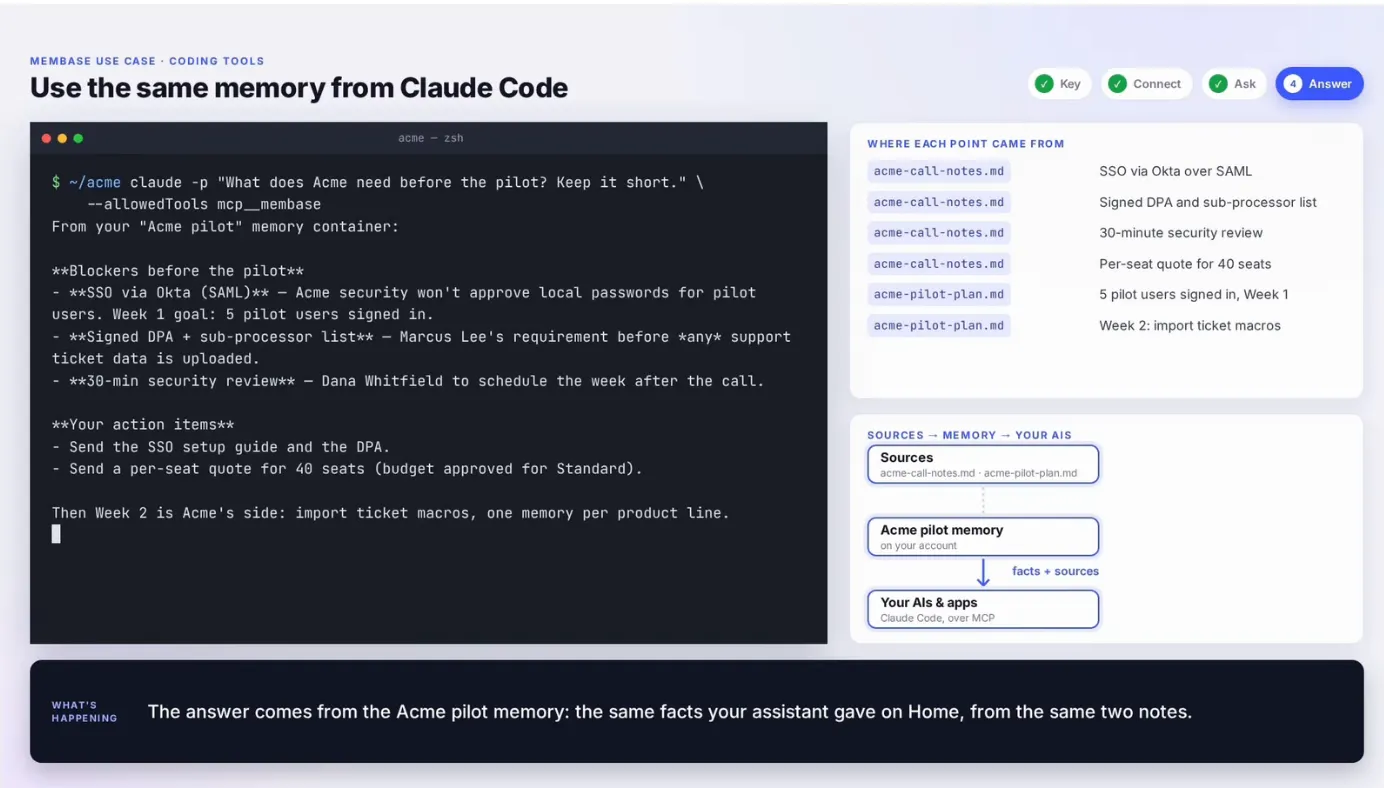
- Best for: teams whose agents and AI tools should share one memory, such as a support bot writing call notes that Claude Code later answers from.
- Strengths:
- One memory across your own code (SDK) and your AI tools (MCP).
- Each key is scoped to specific memories and an access level, and can be revoked at any time. Connecting without a key signs you in with read-only access.
- Every search result comes back with the source file it was learned from.
- Local mode: membase --local mcp runs the same tools against memory on your own machine.
- Core engine: 93.1% on LoCoMo and 92.6% on LongMemEval_S, using up to 11× fewer tokens than the full history (our own numbers; method).
- Watch out for: it’s in beta; the core engine is proprietary; there’s no entity graph; isolation is per account rather than per user_id.
- MCP tools: search_memories, add_memory, add_document, list_containers, list_documents, get_profile, forget_memory, delete_document and more.
- Pricing: Free in beta · Paid plans coming soon.

2. Knowledge Graph Memory Server: the official starting point
The reference memory server from the MCP project stores entities, relations and observations in a local JSONL file.
- Best for: trying MCP memory in a few minutes on one machine.
- Strengths: one npx -y @modelcontextprotocol/server-memory line in your client config; no account; free.
- Watch out for: search is simple text matching with no embeddings; one file on one machine, so no sharing.
- License and pricing: MIT, moving to Apache 2.0 with the rest of the MCP project · free.
3. Basic Memory: memory as Markdown you own
Basic Memory writes memory as Markdown notes with full-text and vector search, so you can open and edit them in Obsidian.
- Best for: people who want to read and correct what their AI remembers.
- Strengths: plain files you control; a cloud option adds remote MCP and a web editor.
- Watch out for: needs Python and uv locally; sync across machines is manual unless you use the cloud plan; AGPL-3.0.
- Pricing: free locally · cloud priced per seat.
4. mcp-memory-service: self-hosted memory for several agents
mcp-memory-service is a self-hosted service with MCP, a REST API and a dashboard.
- Best for: teams that want several agents on one memory, on their own server.
- Strengths: open source, multi-agent, REST API alongside MCP.
- Watch out for: more setup than a single command; it binds to localhost by default, so remote access takes extra configuration.
- License and pricing: Apache 2.0 · free.
5. Mem0: hosted MCP for teams on Mem0
Mem0 offers a hosted MCP server at https://mcp.mem0.ai/mcp, using browser sign-in or a Mem0 API key; its docs include a one-line npx mcp-add setup for Claude Code, Cursor, Windsurf, VS Code and OpenCode. Its older OpenMemory MCP has been deprecated, and the mem0-mcp repository was archived in March 2026.
- Best for: teams already storing memory in Mem0.
- Strengths: LLM-extracted facts with semantic, keyword and entity ranking; outdated facts are superseded automatically on Mem0 Platform; tools to add, search, update and delete memories; a free Hobby tier is enough to start.
- Watch out for: the hosted MCP server stores memory in Mem0’s cloud; retrievals are capped at 1K a month on the free plan; graph memory is listed on the $249 Pro plan.
- Pricing: Hobby free · Starter $19/month · Pro $249/month.
6. Supermemory: hosted MCP with connectors
Supermemory runs a hosted MCP endpoint with OAuth sign-in, team spaces and data connectors.
- Best for: low-ops hosted memory that also pulls in other sources.
- Strengths: nothing to run; sign in from the client and go.
- Watch out for: the documented MCP endpoint is hosted only; self-hosting is on the Scale plan.
- Pricing: free tier · paid plans from $19/month.
7. Graphiti: temporal graph you host yourself
Graphiti, Zep’s open-source engine, has an MCP server that keeps history when facts change.
- Best for: agents that must know what was true before and what is true now.
- Strengths: temporal knowledge graph; open source.
- Watch out for: runs in Docker with a graph database such as FalkorDB or Neo4j; the MCP server is labeled experimental; LLM costs on every write.
- License and pricing: Apache 2.0 · free plus LLM API costs.
8. Cognee: memory built from documents
Cognee builds a knowledge graph plus vectors and exposes tools to remember, recall and forget.
- Best for: memory that comes mostly from documents and internal knowledge.
- Strengths: open source; self-host or use its cloud free tier.
- Watch out for: more setup than file-based servers.
- License and pricing: Apache 2.0 · free self-hosted.
9. Zep Context MCP: managed memory for organizations
Zep’s managed MCP server gives each user their own temporal graph, with single sign-on.
- Best for: organizations that need SSO and a managed service.
- Strengths: per-user graphs; enterprise features.
- Watch out for: someone has to build the data ingestion; proprietary.
- Pricing: from $125/month (Flex).
Why some names are missing
- Letta is an agent platform that connects to MCP tools rather than a memory server other clients connect to.
- OpenMemory (Mem0) is deprecated; use Mem0’s hosted MCP instead.
- Vendor note-taking and company-search tools that expose an MCP endpoint are a different category: they serve existing company knowledge rather than memory your agents write.
How to choose
- To try MCP memory in five minutes → Knowledge Graph server
- Memory you can read and edit as notes → Basic Memory
- One memory for your own agents and Claude Code, Cursor, ChatGPT → Membase
- Each agent with its own scoped, revocable access → Membase
- Answers that cite where each fact came from → Membase
- Hosted, nothing to run → Membase, Supermemory, Mem0
- Self-hosted on your own server → mcp-memory-service, Graphiti, Cognee
- Facts that change over time, with history → Graphiti, Zep
- Memory built from documents → Cognee
- SSO and a managed enterprise service → Zep Context MCP
How to add an MCP memory server to Claude Code, Cursor and Claude Desktop
Claude Code: one command per server. For a hosted HTTP server like Membase, use claude mcp add --transport http … as shown above. For a local npx server, use claude mcp add <name> -- npx -y <package>.
Cursor: add the server under mcpServers in ~/.cursor/mcp.json (or .cursor/mcp.json in a project):
{
  "mcpServers": {
    "membase": {
      "url": "https://api.app.membase.com/mcp-http",
      "headers": { "Authorization": "Bearer mbk_..." }
    }
  }
}
Claude Desktop: local npx servers go in claude_desktop_config.json (Settings › Developer › Edit Config). Hosted servers like Membase are added as a custom connector under Settings › Connectors using the server URL; for Membase this signs you in with read-only access.
Full steps for Membase in each client: Connect your AI. For a full walkthrough with code, see How to Add Long-Term Memory to an AI Agent.
Start building with Membase
- Get an API key: Membase web app → Connect › Developer keys
- MCP server: setup guide · endpoint https://api.app.membase.com/mcp-http
- Python SDK: pip install unibaseio-membase · TypeScript SDK: npm install @unibaseio/membase
- Videos: Give Claude Code permanent memory (MCP) · Add memory with the Membase SDK
- Docs: docs.membase.com · Help: Discord
How we compared
We read each server’s docs, pricing page and GitHub license and Mem0’s current MCP documentation in October 2026. We did not benchmark the servers against each other. Membase is our product, and its numbers come from our own research page. Spot an error? Email support@membase.com and we’ll fix it.
Sources
- Model Context Protocol and the reference memory server
- Basic Memory on GitHub
- mcp-memory-service on GitHub
- Mem0 pricing and Mem0 MCP docs
- Graphiti on GitHub
- Cognee
- Coworker: The 9 best MCP memory servers
- Hjarni: Best MCP memory servers in 2026
- Membase MCP setup, Membase research and the Membase SDK on GitHub