Membase Use Case 03: Knowledge & Productivity — Book Memory, Study Buddy, Browser Memory & Story Bible
AI tools can summarize books, explain complex topics, browse web pages, and help write stories. But what happens when you need them to remember information from yesterday, last week, or across different AI applications?
Most AI workflows still rely heavily on the context available in the current session. Once that context is no longer available, useful information often needs to be provided again.
With persistent memory, AI applications can retain relevant knowledge, retrieve it when needed, and build on previous interactions.
Here are four practical knowledge and productivity use cases built with Membase, using real AI models and runnable demos.
Use Case 1: Book Memory — Let AI Remember What It Reads
The Problem
Imagine asking an AI assistant about a specific passage from a book it has never seen.
Without access to the book’s content, the model may produce an incomplete or incorrect answer. Even if you provided the passage in an earlier session, it may no longer be available.
The Use Case
Book Memory demonstrates how persistent memory helps an AI assistant answer questions using previously stored reading material.
The demo compares two responses side by side: one with access to memory and one without.
The memory-enabled assistant can retrieve relevant passages from a book the model has never read, while the assistant without memory lacks that information.
This approach can support AI reading assistants, research tools, and document-based question-answering applications.
Explore the Demo: Book Memory on GitHub
Use Case 2: Study Buddy — Build an AI Tutor That Remembers Learning Progress
The Problem
Most AI tutors can explain a concept or generate practice questions. But effective learning requires more than answering the current question.
A useful tutor should understand which concepts a student has already mastered and which mistakes they keep repeating.
Without persistent learning history, every study session risks starting from scratch.
The Use Case
Study Buddy combines course material with a student’s learning history.
Instead of providing generic revision exercises, the assistant can retrieve previous mistakes and focus on the areas that need improvement.
For example:
- A student reviews course material and completes practice questions.
- Their mistakes are recorded in memory.
- During a later session, the tutor retrieves the relevant learning history.
- The next review focuses on previously missed concepts.
In the demo, the assistant identifies two earlier mistakes and directs the review toward them.
This pattern is useful for personalized tutoring platforms, exam preparation tools, and adaptive learning applications.
Explore the Demo: Study Buddy on GitHub
Use Case 3: Browser Memory — Turn Browsing History into Searchable Knowledge
The Problem
Developers, researchers, and knowledge workers regularly collect information across websites.
You might read an article on Monday, compare another source on Wednesday, and need both pieces of information on Friday.
Traditional browser history helps you find previously visited URLs, but it does not automatically provide an answer based on the information contained in those pages.
The Use Case
Browser Memory demonstrates how an AI assistant can use information from previously read web pages to answer questions in a later browsing session.
In the demo, a user opens a forecast page and asks a question that depends on information from two pages read several days earlier.
Membase retrieves the relevant stored context, allowing the assistant to use that earlier information when answering.
Potential applications include research assistants, browser-based AI tools, and knowledge management products.
Explore the Demo: Browser Memory on GitHub
Use Case 4: Story Bible — Keep AI Writing Consistent Across Sessions
The Problem
Long-form creative writing requires consistency.
Characters have backgrounds, relationships, motivations, and established histories. Fictional worlds have rules, locations, and timelines.
When writers use multiple AI tools, maintaining these details becomes even more challenging.
A writing assistant may introduce a contradiction because it does not have access to an earlier creative decision.
The Use Case
Story Bible demonstrates how multiple AI writing tools can work with the same persistent creative memory.
The memory acts as a shared reference for established story details.
For example:
- A writer establishes characters, locations, and story rules.
- Those details are stored in shared memory.
- An AI assistant checks a new draft against the established information.
- Another AI tool retrieves the same creative context for subsequent work.
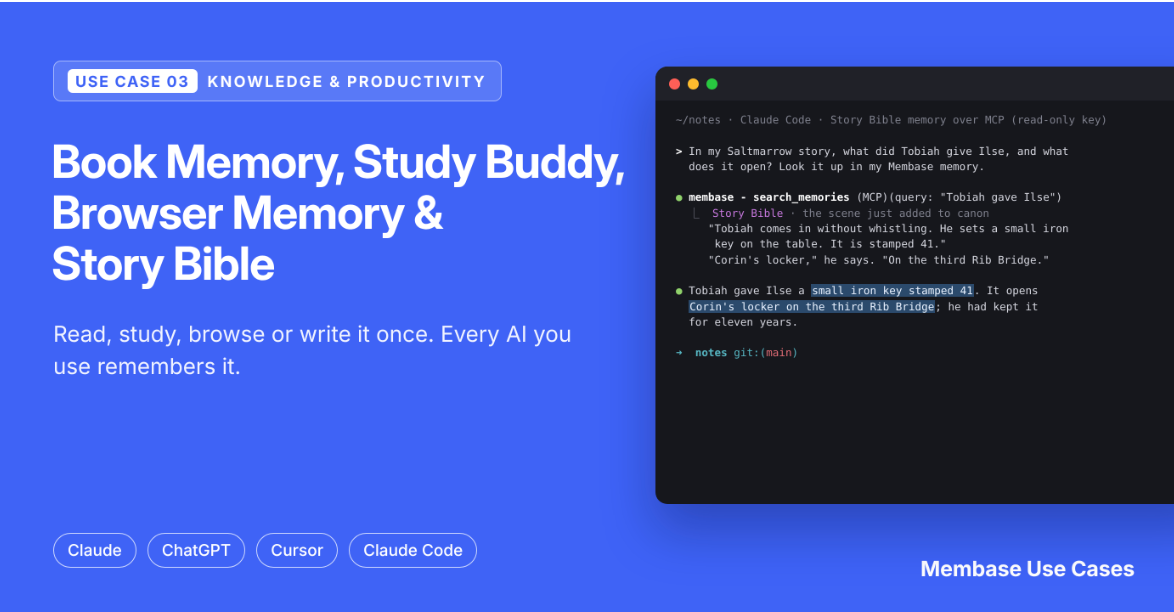
The demo shows a draft being checked against established story canon, while Claude Code accesses the same information.
This makes persistent memory useful for AI-assisted fiction writing, collaborative storytelling, and long-running creative projects.
Explore the Demo: Story Bible on GitHub
How Membase Powers Knowledge and Productivity Applications
These four applications solve different problems, but they share a common requirement: information should remain useful beyond the session in which it was first encountered.
| Use Case | What Memory Enables |
|---|---|
| Book Memory | Retrieve previously stored passages to answer questions |
| Study Buddy | Remember learning progress and recurring mistakes |
| Browser Memory | Recall information from previously visited web pages |
| Story Bible | Maintain consistent creative knowledge across AI tools |
All four demos use Hosted Membase by default and interact with real models and the Membase API.
Developers can explore the source code and reproduce the workflows using the Membase Use Cases repository.
Build Knowledge-Aware AI Applications with Membase
Persistent memory allows AI applications to do more than respond to isolated prompts. It enables them to reuse previously acquired knowledge, personalize future interactions, and maintain continuity across workflows.
Whether you’re building an AI tutor, a research assistant, a reading tool, or a creative writing application, Membase provides a memory layer you can integrate into your application.
Get Started:
Build AI applications that remember what matters.