
Supermemory Alternatives in 2026: 8 AI Memory Tools Compared
Disclosure: Membase is our product. We list it first because it’s the alternative we know best, and we say plainly where Supermemory or another tool is the better fit. Pricing, licenses and features were checked on vendor pricing pages, docs and GitHub in October 2026; see “How we compared” at the end.
Quick links: Get a free Membase API key · Python SDK · MCP server · Docs · GitHub
In this article
- Why teams look for a Supermemory alternative
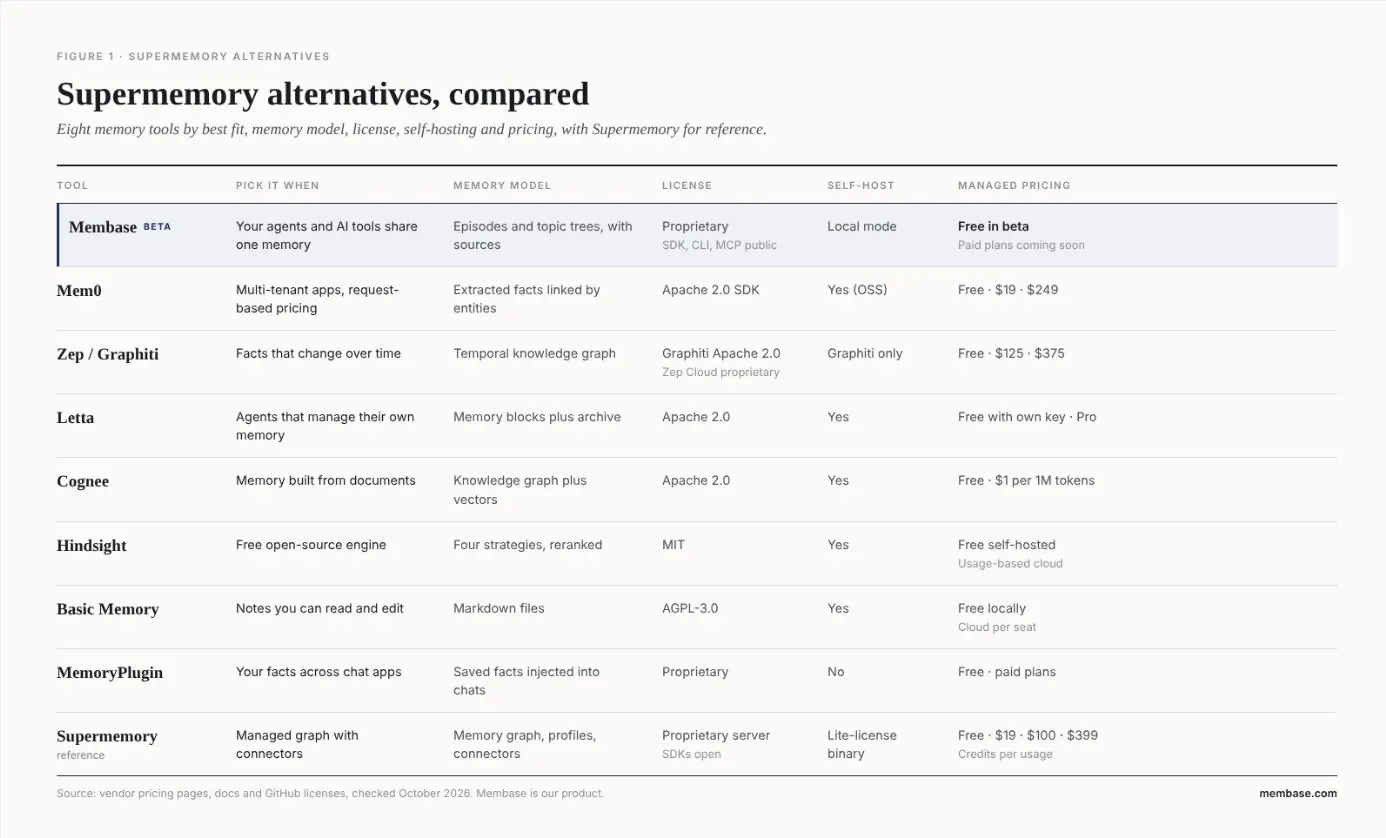
- Supermemory alternatives at a glance
- 1. Membase: one memory for your agents and your AI tools
- 2. Mem0: the default for multi-tenant apps
- 3. Zep and Graphiti: temporal graph memory
- 4. Letta: agents that manage their own memory
- 5. Cognee: memory built from documents
- 6. Hindsight: free, open-source memory engine
- 7. Basic Memory: memory as notes you own
- 8. MemoryPlugin: your facts across chat apps
- If you use Supermemory as a personal “second brain”
- How to choose
- Moving from Supermemory to Membase
- Start building with Membase
- FAQ
- How we compared
- Sources
TL;DR
Supermemory is a strong, fast-moving memory API: a memory graph that updates and forgets facts, user profiles, data connectors and a hosted MCP server. Teams usually look elsewhere for one of five reasons: usage-based billing across several meters, connectors and compliance gated to the $100 and $399 plans, a self-hosted server that isn’t open source, a need for an agent runtime rather than a memory API, or memory meant for a person rather than an app.
- Membase: the memory layer for AI agents. One memory your agents and your AI tools (Claude Code, Cursor, Codex, ChatGPT) share, with read-only access per app by default. Free in beta.
- Mem0: the most widely used memory API, with a user_id model for multi-tenant apps and request-based pricing.
- Zep / Graphiti: a temporal knowledge graph; Graphiti is open source.
- Letta: an agent runtime where agents manage their own memory.
- Cognee: open-source graph memory built from documents.
- Hindsight: an MIT-licensed memory engine you can self-host for free.
- Basic Memory: memory as Markdown notes you own, over MCP.
- MemoryPlugin: a browser extension that carries your facts across chat apps.
- Stay on Supermemory if you want a managed memory graph with built-in connectors to Google Drive, Notion, Gmail and GitHub.
Why teams look for a Supermemory alternative
Supermemory has improved quickly in 2026, and for many apps it’s a good choice. Its graph keeps facts current (“switched from Adidas to Puma” supersedes the old fact), it builds user profiles automatically, and its hosted MCP server lets assistants share memory by space. These are the reasons teams still compare alternatives.
1. Billing runs on several meters. Every plan includes a monthly credit balance (Free $5, Pro $20, Max $130, Scale $600), and calls draw from it at fixed rates: $5 per million tokens for plain-text memory ($10 for rich content), $1–2 per million for its managed RAG, $5 per million search queries and $100 per million operations such as re-ranking. Only unique content is billed, which helps, but forecasting a month means modeling ingestion, search and operations separately. (Supermemory pricing)
2. Connectors and compliance sit on higher plans. The Gmail connector starts on Max ($100 a month). S3 and web-crawler connectors, advanced PDF extraction, SOC 2, a HIPAA BAA and the self-hosted option are on Scale ($399 a month). (Supermemory pricing)
3. The self-hosted server isn’t open source. Supermemory local is a single binary that runs the graph engine on your machine with your own model. It’s free within a “lite license limit”, but its server code is not public, it runs as one tenant with one API key, it doesn’t include connectors, and it collects telemetry unless you turn it off. If you need source you can read and modify, look at the open-source options below. (Supermemory local)
4. You want an agent runtime, not a memory API. Supermemory gives your agent memory to call. Some teams would rather run agents on a platform that manages memory as part of the agent itself.
5. The memory is for a person, not an app. Supermemory’s MCP server and app work for individuals, but the platform is built for developers storing memory per user. If you mainly want your own context to follow you across ChatGPT, Claude and other assistants, a cross-app memory tool may fit better.
Supermemory alternatives at a glance
| Tool | Pick it over Supermemory when | Memory model | License | Self-host | Managed pricing |
|---|---|---|---|---|---|
| Membase (beta) | Your agents and AI tools should share one memory | Episodes and topic trees, each with its source | Proprietary; SDKs, CLI and MCP server are public | Local mode | Free in beta · Paid plans coming soon |
| Mem0 | You run a multi-tenant app and want request-based pricing | Extracted facts linked by entities | Apache 2.0 SDK | Yes (OSS) | Free · $19 · $249 · Enterprise |
| Zep / Graphiti | Facts change over time and you want an open-source graph | Temporal knowledge graph | Graphiti Apache 2.0; Zep Cloud proprietary | Graphiti only | Free (10K credits) · $125 · $375 |
| Letta | Agents should manage their own memory | Self-edited memory blocks plus an archive | Apache 2.0 | Yes | Free with your own model key · Pro · usage-based |
| Cognee | Memory comes mostly from documents | Knowledge graph plus vectors | Apache 2.0 | Yes | Free · $1 per 1M tokens · Enterprise |
| Hindsight | You want a free, open-source engine to self-host | Four retrieval strategies, reranked | MIT | Yes | Free self-hosted · usage-based cloud |
| Basic Memory | You want memory as notes you can read and edit | Markdown files, Obsidian-compatible | AGPL-3.0 | Yes | Free locally · cloud per seat |
| MemoryPlugin | You want your own facts across chat apps, no code | Saved facts injected into chats | Proprietary | No | Free · paid plans |
1. Membase: one memory for your agents and your AI tools
Membase, built by Unibase, is the memory layer for AI agents. Teach it something once, and your own agents, Claude Code, Cursor, Codex and ChatGPT all remember it. Agents use the Python or TypeScript SDK or the REST API; AI tools connect over MCP.
from membase import Membase

m = Membase()  # reads MEMBASE_API_KEY
m.memories.add("Acme requires SSO via Okta before the pilot.", container="Acme pilot")
m.search("what does Acme need before the pilot?")
Why pick it over Supermemory
- One memory for code and tools. Your support agent writes call notes through the SDK, and Claude Code or ChatGPT answers from the same notes over MCP.
- Read-only by default for apps. An AI app connected through Membase’s consent screen can search the memories you tick but can’t add, change or delete anything. Agents that need to write get a developer key with its own level (Read, Read & write, Full), reach and expiry.
- Answers you can trace. Every search result comes back with the memory and the source it was learned from.
- Lower token cost per question. The core engine scores 93.1% on LoCoMo, 92.6% on LongMemEval_S and 92.2% on DMR, using about 3× fewer tokens than the full history on LoCoMo and 11× fewer on LongMemEval_S. These are our own numbers; method and results are at membase.com/research.
- A simple start. Free during beta, with no request quotas, and a local mode: pip install 'unibaseio-membase[local]'.
Watch out for
- It’s in beta. Expect the API to change, and paid plans aren’t published yet.
- Fewer connectors. Membase reads uploaded files, folders, Notion and chat captures from its browser extension; Supermemory connects to more sources, such as Google Drive, Gmail, OneDrive and GitHub.
- Isolation is per account, not per namespace. Each end user connects their own Membase account. If you need thousands of end users behind one server-side key, Supermemory’s namespaces or Mem0’s user_id fit better today.
- No compliance certifications published yet.
Pricing: Free in beta · Paid plans coming soon.
🔑 Try it in two minutes: get a free API key at app.membase.com → Connect › Developer keys, then pip install unibaseio-membase. Step-by-step: How to Add Long-Term Memory to an AI Agent.
See it in a coding agent: Membase Use Case 01 · Coding Agents shows Claude Code, Codex and Gemini CLI remembering decisions across sessions.
2. Mem0: the default for multi-tenant apps
Mem0 extracts facts from conversations and scopes them by user_id, agent_id and run_id. On Mem0 Platform, outdated facts are superseded automatically and memories are linked by shared entities.
- Why pick it over Supermemory: request-based plans (Hobby free with 10K adds and 1K retrievals a month, Starter $19, Pro $249), an Apache 2.0 open-source SDK you can self-host, and the largest community of any memory layer.
- Watch out for: retrievals run out first when several agents share a project; graph memory is listed on the $249 Pro plan.
Full comparison: Membase vs Mem0 · Mem0 alternatives
3. Zep and Graphiti: temporal graph memory
Zep builds a temporal knowledge graph that records when each fact was true. Graphiti, its engine, is open source.
- Why pick it over Supermemory: you can self-host the graph engine under Apache 2.0, and Zep Cloud adds enterprise compliance.
- Watch out for: Graphiti needs a graph database such as Neo4j or FalkorDB and LLM calls on every write; Zep Cloud starts at $125 a month after the free tier.
4. Letta: agents that manage their own memory
Letta (formerly MemGPT) is an agent runtime. Agents edit their own memory blocks and search an archive, so memory is part of the agent rather than a service it calls.
- Why pick it over Supermemory: you want stateful agents and an open-source runtime (Apache 2.0).
- Watch out for: you adopt Letta’s agent model, not just a memory API.
5. Cognee: memory built from documents
Cognee turns documents and conversations into a knowledge graph plus vectors, with open-source pipelines.
- Why pick it over Supermemory: open source under Apache 2.0, strong for document-heavy knowledge, and a simple per-token cloud price.
- Watch out for: more setup than a managed memory API; better suited to knowledge bases than chat personalization.
6. Hindsight: free, open-source memory engine
Hindsight, from Vectorize, runs four retrieval strategies in parallel and reranks the results.
- Why pick it over Supermemory: MIT-licensed and free to self-host, with no license limit.
- Watch out for: you operate it yourself unless you use its usage-based cloud; a smaller ecosystem.
7. Basic Memory: memory as notes you own
Basic Memory stores memory as Markdown files you can open in Obsidian, and exposes them over MCP.
- Why pick it over Supermemory: plain files on your disk that you can read, edit and version-control.
- Watch out for: AGPL-3.0; built for one person’s notes rather than an app’s users; sync across machines needs its cloud plan.
8. MemoryPlugin: your facts across chat apps
MemoryPlugin is a browser extension, custom GPT and MCP server that stores key facts about you and adds them to ChatGPT, Claude and other AI tools.
- Why pick it over Supermemory: you want personal memory across chat apps without writing code.
- Watch out for: it’s a consumer tool, not an API for building your own agents.
If you use Supermemory as a personal “second brain”
Some people use Supermemory to save links, notes and chats for themselves rather than to build an app. If that’s you:
- For memory that follows you across ChatGPT, Claude, Gemini and Grok: Membase’s app and browser extension save your chats into one memory, and each assistant reads it over MCP.
- For notes you control as files: Basic Memory or Obsidian.
- For facts pasted into chats with no setup: MemoryPlugin.
How to choose
- Your agents and Claude Code, Cursor or ChatGPT should share one memory → Membase
- Each AI app should only read the memories you approve → Membase
- Answers must show where each fact came from → Membase
- Multi-tenant app with per-user memory behind one key → Mem0, or stay on Supermemory
- Open-source code you can self-host and modify → Hindsight, Graphiti, Cognee, Letta, Mem0 OSS
- Facts that change over time, with history → Zep / Graphiti
- Agents that manage their own memory → Letta
- Memory built from documents → Cognee
- Built-in connectors to Drive, Gmail, Notion and GitHub → Stay on Supermemory
- Free while you build → Membase (beta), Hindsight, Graphiti, Cognee, Letta (self-hosted)
Moving from Supermemory to Membase
| Supermemory | Membase |
|---|---|
| Namespace per user (user_alex) | One Membase account per user, connected by MCP consent or their own key |
| Namespace per project or space | A container (a Memory), such as Acme pilot |
| add(namespace, {content}) | add(text, container=…, custom_id=…) or memories.add(…) |
| search(namespace, {query}) | search(q, container=…, limit=…) |
| User profile | Profile (get_profile) |
| MCP spaces | Memories you tick per app on the consent screen |
- List and export your documents from Supermemory (for example with its document list and get endpoints).
- Write each one into the matching container, using the Supermemory document ID as custom_id, so re-running the import never creates duplicates.
- Keep dates: put the original date in the text when it matters, and never merge different users into one container.
- Point your agents’ SDK calls and your MCP clients at Membase.
- Keep Supermemory read access until you’ve compared answers on your own test questions.
Start building with Membase
- Get an API key: Membase web app → Connect › Developer keys
- Python SDK: pip install unibaseio-membase · PyPI
- TypeScript SDK: npm install @unibaseio/membase · npm
- MCP server: setup guide · https://api.app.membase.com/mcp-http
- Videos: Add memory with the Membase SDK · Give Claude Code permanent memory (MCP)
- Docs: docs.membase.com · Help: Discord
How we compared
We read each vendor’s pricing page, docs and GitHub license in October 2026, including Supermemory’s pricing, graph memory, MCP and self-hosting documentation. We did not benchmark the tools against each other; Membase’s numbers come from our own research page. Membase is our product. Spot an error? Email support@membase.com and we’ll fix it.